
AI is changing how work gets done. However, most teams are not ready for it. In fact, a 2024 McKinsey report found that only 1 in 5 employees feels confident using AI tools at work. That gap is a big problem. Building an AI literate team is no longer optional. It is a business need. This guide will show you exactly how to do it — step by step.
AI literacy means understanding what AI can do, how it works, and when to use it. It does not mean becoming a data scientist. Instead, it means your team can use AI tools wisely and safely. Consequently, teams with AI literacy make faster decisions. They spot better opportunities. Moreover, they avoid costly mistakes that come from misusing AI.
Think about email automation, content generation, or customer support bots. All of these rely on AI. Without AI literacy, your staff may fear these tools — or worse, misuse them. Therefore, upskilling your team is the smartest investment you can make right now.
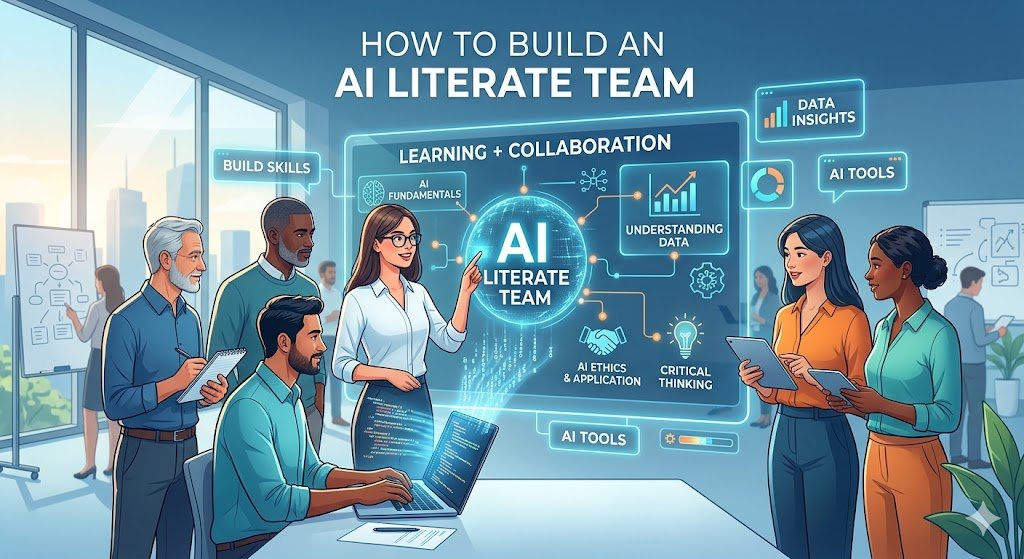
Before you build anything, you need to know where your team stands. Start with a simple survey. Ask employees how often they use AI tools. Find out what they already know. Additionally, check which departments could benefit most from AI right now.
Use tools like Google Forms or Typeform to run this assessment. Then, group your team by skill level — beginners, intermediate users, and advanced. This grouping helps you tailor training to each level. Moreover, it saves time and avoids frustrating your more experienced staff.
Key areas to assess include: prompt writing skills, understanding of AI bias, data privacy awareness, and tool-specific knowledge (ChatGPT, Copilot, Gemini, etc.).
A training programme without goals gets nowhere. Therefore, set SMART goals for your AI learning initiative. For example, your goal might be: ‘Within 60 days, all marketing staff will use AI to draft first-pass content.’ That is specific, measurable, and realistic.
Align these goals with business outcomes. Additionally, connect AI learning to KPIs your team already cares about. This makes the training feel relevant, not like a box-ticking exercise.
Common AI literacy goals include: reducing manual tasks by 30%, cutting content production time in half, or improving customer response times using AI chatbots. Pick goals that make sense for your industry.
There are hundreds of AI courses out there. However, not all of them are practical. Look for training that is hands-on, role-specific, and up to date. Platforms like Coursera, LinkedIn Learning, and Google’s AI Essentials are excellent starting points.
For internal training, consider lunch-and-learn sessions. These work well because they are low pressure. Furthermore, they let experienced team members share what they know. Peer learning builds confidence faster than solo online courses.
Also, invest in tool-specific training. If your team uses Notion AI or HubSpot’s AI features, train them on those tools directly. Generic AI knowledge is useful, but practical tool skills drive real results.
Training alone is not enough. Your team needs space to try things out. Consequently, build an environment where it is safe to experiment with AI — and safe to fail. Celebrate small wins. Share examples of AI saving time or improving output.
Set up an internal AI channel on Slack or Teams. Use it to share prompts, tips, and results. Additionally, run monthly challenges — like who can build the best AI workflow this month. Friendly competition drives adoption faster than mandatory training.
Leaders must model the behaviour they want to see. When managers use AI openly and talk about it honestly, the rest of the team follows. Therefore, start at the top.
AI literacy is not just about knowing how to use tools. It also means knowing when not to use them. Train your team on data privacy rules. Make sure everyone knows not to paste client data into public AI tools like free ChatGPT.
Cover topics like AI hallucinations — when AI generates confident but wrong information. Teach your team to verify AI outputs before acting on them. Additionally, discuss AI bias and how it can affect outputs.
Build a simple internal AI policy. It does not need to be long. However, it should clearly cover what tools are approved, what data can be used, and what outputs need human review.
You cannot manage what you do not measure. Therefore, track AI adoption across your team. Look at usage rates for AI tools. Check whether training goals are being met. Survey employees again after 30 and 60 days to see how confidence has grown.
Use this data to improve your programme. Furthermore, celebrate progress publicly. Recognise team members who have embraced AI tools. This positive reinforcement builds momentum.
Update training content regularly. AI tools change fast. Consequently, your learning programme needs to keep pace. Schedule a quarterly review of all AI training materials and tools.
Many organisations rush AI training without a plan. This leads to confusion and low adoption. Avoid the mistake of running one-off workshops and calling it done. Consistent, ongoing learning is the key.
Do not ignore resistance. Some team members will push back on AI. Instead of forcing the issue, listen to their concerns. Often, fear of job loss drives resistance. Address it head-on with honest, transparent conversations.
Also, avoid choosing tools before you understand your team’s needs. Start with needs, then find the tools that meet them. Moreover, do not assume technical staff need less training — they often need it most for non-technical AI use cases.
AI literacy is not a one-time project. It is an ongoing capability that grows with your team. Therefore, embed AI learning into your onboarding process. Make it part of how new hires get up to speed from day one.
Create AI champions within each department. These are enthusiastic team members who keep their peers engaged and updated. Furthermore, connect them regularly to share insights across the business.
In conclusion, building an AI literate team takes time, intention, and consistent effort. However, the return is enormous. Teams that understand AI work smarter, move faster, and deliver better results. Start today — and your organisation will be ready for whatever AI brings next.
Read More:
Why Prompt Engineering Is Every Leader’s New Skill
