
Artificial intelligence is no longer just a technology topic. It has become a governance issue. And increasingly, it is landing squarely on the boardroom table. Across industries, boards are being asked tough questions. Who is accountable when an AI system causes harm? How do we ensure our AI tools are fair, transparent, and compliant? And are our directors actually equipped to oversee this fast-moving space?
These are not easy questions. However, they are exactly the right ones to be asking. Because companies that get AI governance right will build stronger trust, reduce regulatory risk, and unlock sustainable competitive advantage.
So, let’s break it all down — clearly, practically, and without the jargon.
Not long ago, artificial intelligence sat firmly in the IT department. Decisions about algorithms, data pipelines, and machine learning models were left to engineers and data scientists. The board, quite frankly, didn’t need to be involved.
But that has changed dramatically. AI now touches every part of the enterprise — from hiring decisions and customer credit scoring to supply chain management and clinical diagnostics. As a result, the risks associated with AI have become enterprise-wide risks.
Consider just a few examples. An algorithmic hiring tool discovered to be biased against women. A financial AI model making faulty loan decisions due to flawed training data. A healthcare platform using patient data in ways that violate privacy regulations. In each case, the reputational, legal, and financial fallout reaches far beyond the tech team. Ultimately, it becomes a board-level crisis.
Moreover, regulators are catching up fast. The EU AI Act is now in force. The UK’s AI Safety Institute is actively shaping global standards. Meanwhile, the US Securities and Exchange Commission is requiring greater disclosure of AI-related risks. Boards that are not actively governing AI are already falling behind.
At its core, AI governance is about accountability. It means putting proper structures in place to ensure AI is used responsibly, ethically, and in line with the company’s values and legal obligations.
For a board, this involves several key responsibilities.
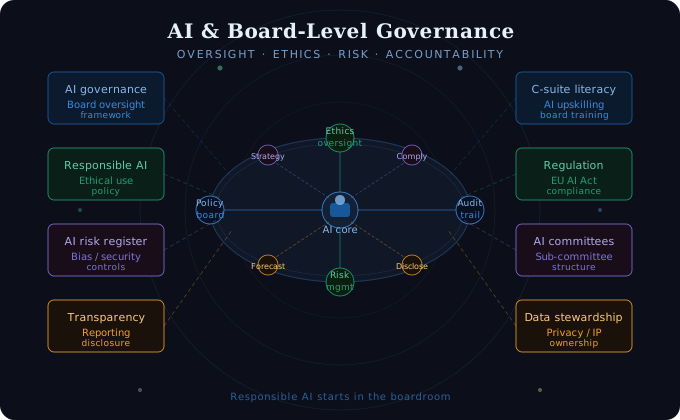
Setting the tone at the top. First and foremost, boards need to signal that AI governance matters. This means formally including AI risk in the board’s oversight mandate. It also means approving a clear AI policy — one that defines how AI can and cannot be used within the organisation.
Understanding the risk landscape. AI introduces a new category of risk. These include algorithmic bias, data privacy breaches, model opacity, third-party AI vendor risks, and cybersecurity vulnerabilities tied to AI systems. Boards must understand these risks at a sufficient level to provide meaningful oversight — even if they are not technical experts themselves.
Ensuring regulatory compliance. Compliance with AI-related laws and standards is rapidly becoming a non-negotiable. Boards need assurance that management has mapped out relevant regulations and has robust processes in place to meet them. Additionally, boards should be asking how the company is preparing for regulations that are still emerging.
Demanding transparency and explainability. Where AI systems are making — or influencing — significant decisions, boards should ask how those decisions can be explained. Black-box AI that nobody can interpret is a governance red flag. Responsible AI frameworks require that decisions be explainable to stakeholders, regulators, and those affected by the outcomes.
So, how should boards go about structuring AI governance? There is no single template that fits every organisation. Nevertheless, there are some clear building blocks that effective frameworks share.
Establish a dedicated AI oversight committee. Many leading boards are now creating AI sub-committees — similar in structure to audit or remuneration committees. These groups meet regularly, review AI risk reports, and advise the full board. In some cases, companies are also appointing a Chief AI Officer or Chief Ethics Officer to sit alongside the CTO and CEO in governance conversations.
Create an AI risk register. Every significant AI system the company uses — whether internally built or sourced from a third party — should be catalogued. For each system, the register should capture its purpose, the data it uses, the decisions it influences, and the risks it carries. Furthermore, the register should be reviewed and updated at least quarterly.
Implement regular AI audits. Just as financial audits provide assurance on numbers, AI audits provide assurance on algorithmic fairness, data quality, model performance, and compliance. These audits can be conducted internally or by specialist third parties. Either way, the results should flow up to the board.
Set clear accountability lines. Someone must own AI governance at the executive level. Boards should ensure that accountability is clearly assigned — not spread across multiple teams with no one holding ultimate responsibility. Clear ownership drives better outcomes.
Here is a critical and often uncomfortable truth. Most boards are not yet equipped to govern AI effectively.
Research from the World Economic Forum and various governance institutes consistently shows that the majority of corporate directors lack confidence in their AI literacy. They don’t understand how large language models work. They struggle to interpret an AI audit report. And they don’t know which questions to ask management when AI risks are presented.
This is a serious problem. Fortunately, however, it is a solvable one.
Boards can — and should — invest in AI literacy programmes. These don’t require directors to become data scientists. Rather, they help directors understand enough to ask the right questions, challenge management effectively, and make informed governance decisions. Several reputable institutions now offer board-level AI education modules specifically designed for this purpose.
Additionally, boards should consider whether they have the right mix of expertise around the table. Recruiting directors with backgrounds in technology, data science, or AI ethics can meaningfully strengthen the board’s collective capability. Alternatively, boards can engage independent AI advisors to support their oversight role.
Beyond compliance and risk management, there is a compelling business case for getting AI governance right — and it centres on trust.
Customers, employees, investors, and regulators are all paying closer attention to how organisations use AI. Studies show that consumers are more likely to trust — and remain loyal to — companies that can demonstrate transparent, ethical AI practices. Investors, similarly, are beginning to factor AI governance into ESG assessments.
In other words, strong AI governance is not just about avoiding harm. It is also about building the credibility that drives long-term value. Companies that can say, with evidence, “here is how we govern AI responsibly” will enjoy a meaningful trust advantage over those that cannot.
If your board has not yet formally addressed AI governance, the starting point does not need to be complicated.
Begin with a simple board-level conversation. Ask management to present a current inventory of AI systems in use across the organisation. From there, identify the three to five highest-risk applications and examine what oversight exists for each.
Next, check whether your existing governance frameworks — risk management, compliance, audit — adequately cover AI-related risks. In most cases, they will need to be updated or extended. Equally, review whether board-level reporting on AI is regular, structured, and meaningful.
From those foundations, a more comprehensive framework can be built over time. The key is to start now — before a crisis forces the issue.
Artificial intelligence is reshaping business at speed. Boards that treat AI governance as a technical afterthought are taking on enormous risk — regulatory, reputational, and ethical.
The good news is that effective board-level AI governance is well within reach. It requires the right structures, the right skills, and above all, the right mindset — one that sees AI not just as a tool for growth, but as a responsibility that demands serious oversight.
Because in the end, trustworthy AI starts at the top.
Read More:
