
AI is no longer optional. Today, businesses run on it. Hospitals use it to read scans. Banks rely on it to detect fraud. Airlines trust it to manage flight paths. When AI fails, real harm follows.
So the question is simple: how do you build AI systems that never let you down? That is where mission critical AI infrastructure comes in. It is the backbone that keeps intelligent systems running, even under pressure.
Mission critical AI infrastructure refers to the computing, networking, and software systems that support AI workloads with zero tolerance for failure. These are not experimental tools. They serve industries where downtime equals disaster.
Think about air traffic control. Consider emergency response systems. Also think about financial trading platforms. Each depends on AI that must work every second of every day. Therefore, the infrastructure must be built differently from standard IT systems. It needs special design, special tools, and special oversight.
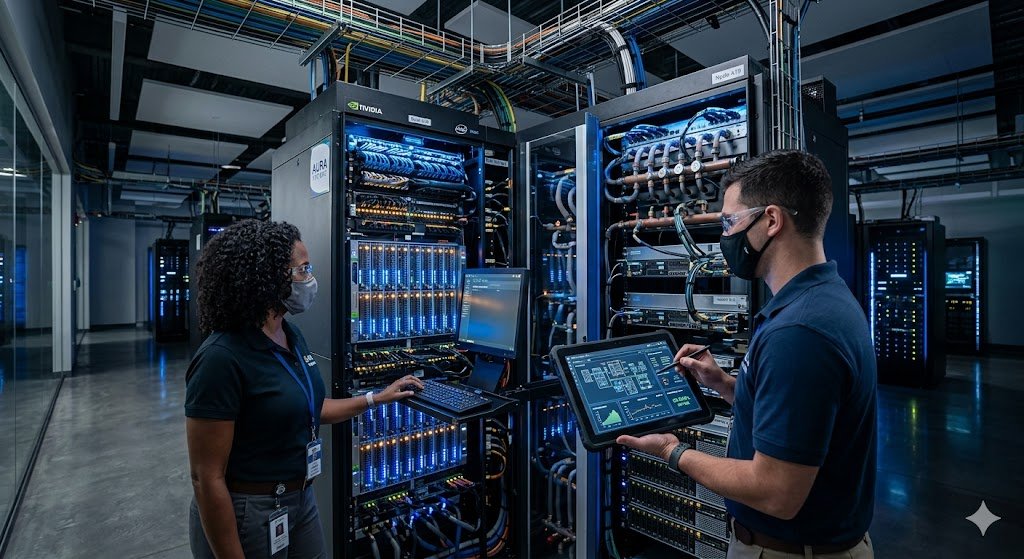
First, you need high-availability compute. Graphics Processing Units (GPUs) and Tensor Processing Units (TPUs) power AI models. Without them, inference stops. Redundant hardware ensures no single failure breaks the system.
Second, low-latency networking matters greatly. AI models move massive amounts of data. Slow networks cause bottlenecks. Fast, dedicated connections keep response times tight.
Third, distributed storage plays a key role. AI needs enormous datasets. Storing them across multiple nodes prevents data loss and speeds retrieval. Finally, observability tools complete the picture. Real-time monitoring, alerting, and logging help teams catch issues before they become crises. Together, these components form the foundation of any dependable AI system.
Redundancy means having backup systems ready to take over instantly. Failover is the process of switching to those backups without interruption. For mission critical AI, both are non-negotiable. Active-active configurations keep multiple systems running simultaneously. Active-passive setups keep one system on standby.
Furthermore, geographic redundancy adds another layer. Hosting infrastructure in multiple data centers protects against regional outages. Natural disasters, power failures, and cyberattacks cannot take down your entire operation.
Consequently, businesses that invest in redundancy lose far less revenue during incidents. The upfront cost is high. However, the cost of downtime is always higher.
AI infrastructure faces unique security threats. Adversarial attacks can manipulate model inputs. Data poisoning corrupts training sets. Model theft exposes intellectual property. Strong encryption protects data in transit and at rest. Role-based access control limits who can touch what. Continuous vulnerability scanning catches weaknesses before attackers do.
Additionally, AI-specific security practices matter. Model versioning allows quick rollback after an attack. Sandboxed inference environments contain damage if something goes wrong.
Moreover, compliance frameworks like SOC 2, ISO 27001, and HIPAA set the bar for regulated industries. Meeting them is not optional. It is the price of operating in sensitive sectors.
AI workloads spike. A product recommendation engine handles ten times more traffic during a sale. A fraud detection system sees surges during holiday shopping. Infrastructure must scale without degrading performance. Auto-scaling tools handle this automatically. Kubernetes, for example, spins up new containers when demand rises and tears them down when traffic drops. Cloud-native architectures make scaling even easier.
However, scaling alone is not enough. You also need performance tuning. Model quantization reduces the size of AI models without killing accuracy. Caching stores repeated inference results to avoid redundant computation.
As a result, well-tuned infrastructure delivers fast responses even under peak load. Users never notice the strain behind the scenes.
You cannot fix what you cannot see. That is why observability is central to mission critical AI infrastructure. Good observability covers three pillars: metrics, logs, and traces. Metrics show system health at a glance. Logs capture detailed event records. Traces follow a single request across multiple services.
Tools like Prometheus, Grafana, and Datadog make this possible. They alert teams the moment something looks wrong. Automated runbooks can even resolve common issues without human intervention.
Besides technical metrics, AI-specific monitoring is essential. Tracking model drift, prediction accuracy, and data quality ensures the AI itself stays healthy, not just the hardware around it.
Even the best systems fail sometimes. Disaster recovery planning prepares you for that reality. Recovery Time Objective (RTO) defines how fast you must recover. Recovery Point Objective (RPO) defines how much data loss you can tolerate. Both guide your backup and restoration strategy.
Regular drills test whether your plan actually works. Table-top exercises walk teams through scenarios. Full failover tests prove that backups can carry real production load. Ultimately, a tested disaster recovery plan is a competitive advantage. It proves to customers and regulators that your AI systems are trustworthy.
MLOps brings DevOps discipline to machine learning. It connects model development with production deployment in a structured, repeatable way. Continuous integration and continuous delivery (CI/CD) pipelines automate model testing and deployment. Every change goes through a gated process. No untested model reaches production.
Model registries track versions and metadata. Feature stores provide consistent, reusable data for training and inference. Together, these practices reduce risk and improve reliability.
Furthermore, MLOps enables faster iteration. Teams can update models frequently without destabilising the infrastructure underneath them.
Mission critical does not have to mean unlimited spending. Smart architecture choices reduce costs without cutting corners on reliability.
Spot instances handle non-urgent batch workloads at a fraction of the cost. Reserved instances lower prices for predictable, steady-state workloads. Rightsizing eliminates waste by matching compute to actual needs.
Additionally, multi-cloud strategies prevent vendor lock-in and allow price comparison across providers. FinOps practices bring financial accountability to cloud spending without slowing engineering teams down.
In short, disciplined cost management makes mission critical AI infrastructure sustainable over the long term.
Edge computing is moving AI closer to the data source. Instead of sending data to a central cloud, edge devices run inference locally. This cuts latency and reduces bandwidth costs.
Neuromorphic chips mimic the human brain. They process data more efficiently than traditional GPUs for certain AI tasks. Though still emerging, they promise a step change in performance per watt. Quantum computing looms on the horizon. It will not replace classical infrastructure soon.
However, hybrid quantum-classical systems could solve optimisation problems that today’s machines cannot. Consequently, organisations that build flexible, modular infrastructure today will adapt more easily to these shifts tomorrow.
Mission critical AI infrastructure is the difference between AI that works and AI that fails when it matters most. Building it requires careful planning across compute, networking, security, scalability, and observability.
The stakes are high. However, the path is clear. Invest in redundancy. Enforce security. Embrace MLOps. Monitor everything. Plan for disaster before disaster arrives. Businesses that get this right do not just survive disruptions. They use their AI advantage to pull ahead of competitors who are still recovering.
Read More:
Outcome Based Pricing in AI Businesses: Complete Guide
