
How to Execute Business Strategy Using AI Agents
Introduction
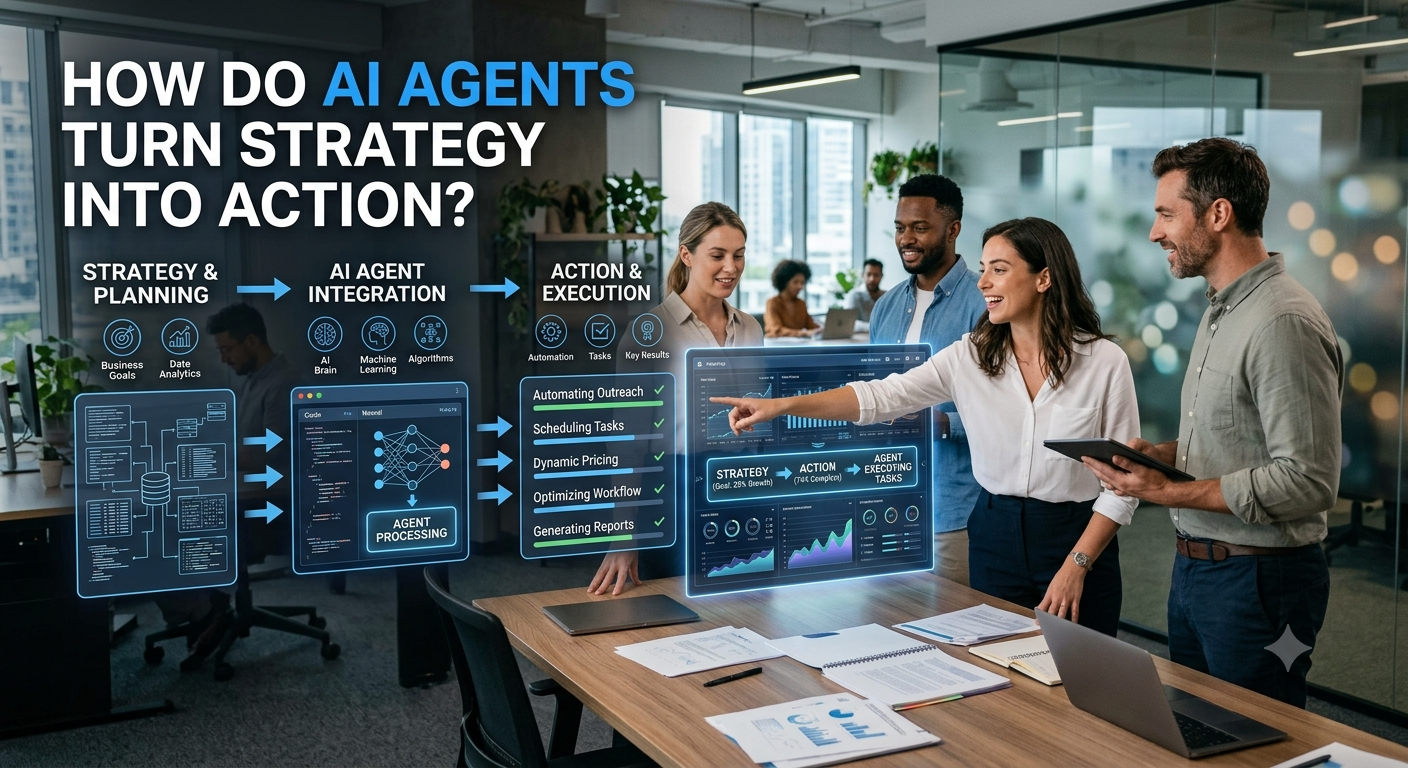
Most business strategies fail during execution, not during planning. Leaders spend weeks building a roadmap. Then the plan sits in a slide deck and collects dust. AI agents are changing that pattern. These digital workers can monitor goals, assign tasks, and flag risks in real time. As a result, teams move from static planning to active strategy execution. This guide explains how to execute business strategy using AI agents, step by step. You will learn what these tools do, why they matter, and how to put them to work in your organization. Whether you run a startup or manage a large team, this approach can help you turn plans into measurable results. Instead of chasing status updates, you will finally see execution happen in real time, across every department that matters.
What Are AI Agents in Business Strategy
AI agents are software programs that act on your behalf. Unlike simple chatbots, they can complete multi-step tasks without constant supervision. For example, an AI agent might track a sales target. It can then adjust outreach schedules automatically when numbers slip. This is different from traditional automation, which only follows fixed rules. AI agents use data and context to make decisions along the way.
In a strategic setting, these agents connect to your key systems. They pull data from CRMs, project tools, and financial dashboards. Consequently, they build a live picture of how your strategy is performing. Instead of a quarterly review, you get continuous feedback. This shift matters because markets move fast. A plan that made sense in January may need changes by March. AI agents help you catch that shift early.
Many companies already use AI agents for narrow tasks like scheduling or customer support. However, the bigger opportunity lies in strategic execution. Here, agents coordinate across departments. They also translate high-level goals into daily actions for each team.
Why Businesses Need AI Agents for Strategy Execution
Strategy execution has always been the hardest part of business planning. Research consistently shows that most strategic initiatives miss their targets. The reasons are familiar: poor communication, unclear ownership, and slow feedback loops. AI agents attack each of these problems directly.
First, they improve communication by keeping everyone aligned on the same data. Teams no longer argue over whose spreadsheet is correct. Instead, the agent pulls from one verified source. Second, AI agents assign clear ownership. Each task links to a person, a deadline, and a measurable outcome. Third, feedback becomes immediate rather than delayed. Managers see problems the day they appear, not the month after.
Furthermore, AI agents reduce the burden on middle managers. These leaders often spend hours compiling status reports. An agent can generate that report automatically, freeing up time for actual decision-making. This matters most for growing companies. As headcount increases, coordination becomes harder. AI agents scale that coordination without adding more meetings.
Small businesses benefit too. A founder cannot personally track every metric across sales, product, and support. An AI agent can watch all three at once and surface only what needs human attention. This lets lean teams compete with larger, better-resourced rivals.
There is also a cost argument worth considering. Hiring additional analysts or coordinators to track strategy manually is expensive. An AI agent handles repetitive monitoring at a fraction of that cost. This frees budget for work that truly needs human creativity, such as customer relationships or product design. Similarly, AI agents do not get tired or distracted. They apply the same level of attention to every metric, every single day. That consistency is difficult for even the most dedicated human team to match over long periods.
How to Implement AI Agents in Your Strategic Plan
Getting started does not require a massive technology overhaul. You can introduce AI agents in stages, starting with a single strategic priority.
Begin by defining one clear goal, such as increasing customer retention by ten percent. Next, identify the data sources connected to that goal. This might include your support tickets, product usage logs, and billing system. Then, choose an AI agent platform that can integrate with those tools. Many modern platforms offer prep-built connectors for common software.
Once connected, set clear rules for what the agent should track and report. For example, you might ask it to flag any account with declining usage for two weeks in a row. The agent can then notify the account manager automatically. This removes the guesswork from prioritization.
After the first agent proves useful, expand to a second strategic area. Common next steps include hiring pipelines, marketing funnels, and financial forecasting. As you add agents, keep humans in the loop for major decisions. AI agents should support judgment, not replace it entirely.
Training your team matters just as much as the technology. Employees need to understand how to read agent reports and act on them quickly. Otherwise, valuable insights go unused. Similarly, leadership should review agent outputs during regular strategy meetings. This keeps the technology tied to real business outcomes, not just dashboards nobody checks.
It also helps to assign a single owner for each AI agent you deploy. This person checks that the agent still reflects current priorities. Business goals shift throughout the year, and an unmonitored agent can quietly drift out of relevance. A monthly check-in is usually enough to keep everything aligned. Additionally, document how each agent makes its recommendations. This record helps new employees understand the system quickly, and it gives leadership a clear audit trail when reviewing results.
Common Challenges and How to Solve Them
Adopting AI agents is not without friction. Teams often face three recurring challenges: data quality, trust, and change management.
Data quality comes first. An AI agent is only as good as the information it receives. If your CRM has outdated contacts or duplicate records, the agent will make flawed recommendations. Therefore, invest time in cleaning your data before full deployment. This step pays off quickly once the agent starts working with accurate inputs.
Trust is the second challenge. Employees may hesitate to follow suggestions from a machine, especially early on. To build trust, start with low-risk tasks where mistakes are easy to correct. Show your team the agent’s reasoning, not just its conclusions. Over time, as accuracy improves, confidence grows naturally.
Change management rounds out the list. Introducing new tools disrupts existing habits. Employees may feel that an agent is monitoring them rather than helping them. Address this directly by framing the technology as a support system. Explain that the goal is fewer wasted hours, not increased surveillance.
Finally, avoid overloading a single agent with too many responsibilities. Specialized agents that handle one function well tend to outperform generalist tools that try to do everything. Keep scope narrow, measure results, and expand only when the value is clear.
Security deserves attention as well. AI agents often need access to sensitive business systems, including financial and customer data. Set clear permissions so each agent only reaches the information it truly needs. Review these permissions regularly, especially as your strategy and team structure evolve. A well-governed agent protects your business, while a poorly managed one can create unnecessary risk.
Conclusion
Executing business strategy has always required discipline, communication, and fast feedback. AI agents now make all three easier to achieve. By automating monitoring, clarifying ownership, and reducing manual reporting, these tools help strategy move from paper to practice. Start small, choose one goal, and build from there. Momentum tends to build quickly once the first agent delivers a visible win, making the next rollout far easier to justify. Over time, your organization can run a strategy execution process that adapts as quickly as the market does. Build your authority with Ruben Ghosh and turn ambitious plans into consistent, measurable results.
Frequently Asked Questions
1. What is the difference between AI agents and automation?
Automation follows fixed rules without adapting. AI agents use data and context to make decisions, adjusting their actions as conditions change.
2. Can small businesses use AI agents for strategy execution?
Yes. Small teams often benefit the most, since a single agent can monitor multiple metrics that a founder cannot track alone.
3. How long does it take to implement AI agents in a strategic plan?
Most businesses can launch a first use case within a few weeks, especially when starting with one clear, well-defined goal.
4. Do AI agents replace human decision-making?
No. AI agents support decisions by surfacing timely data. Final strategic choices should still involve human judgment.
5. What is the biggest risk when adopting AI agents for strategy?
Poor data quality is the most common risk. Clean, accurate data ensures the agent produces reliable recommendations.
Also Read:
How Do You Go From AI Hype to Real Results? An Ultimate Guide
Can AI Strategy Execution Fix Your Tech Roadmap? Ultimate Guide