
Choosing between build vs buy AI is one of the biggest decisions a growing company can face. Mid-sized companies often sit in a tricky spot. You have more resources than a startup. However, you rarely have the budget or bench strength of a large enterprise. This makes the build vs buy AI question feel especially high stakes.
Every leader wants AI that actually works. Nobody wants to waste months and money on the wrong path. In this guide, we will break down what building AI in-house really involves. We will also cover what buying AI software looks like in practice. By the end, you will have a clear framework for making this call with confidence.
Building AI means creating custom models, tools, or systems from scratch. Your team owns the code, the data pipelines, and the ongoing maintenance. This path offers deep control. It also demands serious technical talent and time.
Buying AI means licensing an existing platform or tool. A vendor handles the engineering. You focus on using the product to solve business problems. This path is usually faster. However, it can limit flexibility down the road.
Mid-sized companies often assume they must pick one lane forever. That is not true. Many successful firms blend both approaches. They buy general tools for common tasks. Meanwhile, they build custom solutions for their unique competitive edge. Therefore, the real question is not build or buy. Instead, it is where each approach makes the most sense.
It also helps to think about this decision as a spectrum rather than a switch. On one end, you have fully custom AI systems built entirely in-house. On the other end, you have ready-made platforms you simply plug into your workflow. Most mid-sized companies land somewhere in the middle. They might customize an existing platform, or build a lightweight internal tool on top of a vendor’s API. Recognizing this middle ground can open up options you might not have considered at first.
Several factors shape whether building AI in-house or buying AI software fits your business better. Consider each one carefully before committing resources.
Budget and total cost of ownership. Buying AI often looks cheaper at first glance. Subscription fees are predictable. Building AI requires upfront investment in talent, infrastructure, and data preparation. However, buying can become expensive over time as usage scales. Weigh both short-term and long-term costs.
Speed to market. If you need a solution quickly, buying AI usually wins. Vendors have already solved many technical problems. Building AI from scratch can take months, sometimes longer. For urgent needs, speed often outweighs customization.
In-house technical talent. Building AI requires skilled engineers, data scientists, and MLOps support. Mid-sized companies rarely have large AI teams. If your talent pool is thin, buying reduces risk significantly. Conversely, if you already have strong technical staff, building becomes more realistic.
Data ownership and privacy. Some industries face strict data regulations. Building in-house gives you full control over how data is stored and used. Buying AI means trusting a third party with sensitive information. For regulated industries, this factor carries serious weight.
Competitive differentiation. Ask yourself whether the AI capability is core to your competitive advantage. If it is something every competitor also needs, buying makes sense. If it is central to what makes your business unique, building may be worth the investment.
Integration with existing systems. Consider how well a new AI tool will fit into your current tech stack. Buying a platform that does not integrate smoothly can create hidden costs down the line. Building in-house allows you to design around your existing systems from the start, though this also takes extra engineering time.
Vendor stability and roadmap. When you buy AI, you become dependent on that vendor’s future decisions. Pricing changes, feature removals, or even a company shutting down can disrupt your operations. Before signing a contract, research the vendor’s track record and financial stability. This due diligence can prevent painful surprises later.
Buying AI software is often the smarter choice for mid-sized companies. Here is why. Vendors specialize in solving specific problems at scale. They invest heavily in research and development that most companies simply cannot match. As a result, buying gives you access to cutting-edge tools without the overhead.
Buying also reduces risk. You are not betting your budget on an unproven internal project. Instead, you are adopting a tested solution with a track record. Additionally, most vendors offer support, updates, and security patches. This means less burden on your internal team.
For common use cases like customer service chatbots, marketing automation, or basic analytics, buying is usually the right call. These tools do not typically require deep customization. Furthermore, switching vendors later is often easier than unwinding a custom-built system.
Buying also allows your team to focus on core business goals instead of infrastructure. Your engineers can spend time on product features that directly serve customers. Meanwhile, the vendor handles the heavy technical lifting behind the scenes. For many mid-sized companies, this tradeoff is well worth the subscription cost.
Building AI in-house makes sense in specific situations. If your business has a truly unique workflow, off-the-shelf tools may not fit well. Custom-built AI can be tailored precisely to your processes. This can create a real competitive advantage over time.
Building also makes sense when data sensitivity is extremely high. Some companies cannot risk sending proprietary data to outside vendors. In these cases, in-house development offers peace of mind. Similarly, companies with long-term AI ambitions may want to build internal expertise early. This investment can pay off as AI becomes more central to the business.
That said, building requires patience. Expect a longer timeline before you see results. You will also need ongoing investment to maintain and improve the system. Mid-sized companies should only pursue this path with realistic expectations and strong leadership support.
Building also gives you leverage in negotiations with future partners or acquirers. Owning your own AI capability can become a valuable asset. It shows investors and partners that your company has real technical depth. Consequently, some mid-sized firms choose to build even when buying would be faster, simply because ownership fits their long-term vision.
Here is a simple way to approach the build vs buy AI decision. First, list your specific use case and desired outcome. Next, evaluate how unique this need is to your business. Then, assess your available budget, timeline, and technical talent. Finally, weigh the long-term costs of each option against the expected value.
For most mid-sized companies, a hybrid approach works best. Buy proven tools for standard needs. Build custom solutions only where they create real strategic value. This balanced strategy reduces risk while still allowing room for innovation. As your company grows, you can revisit this balance and adjust as needed.
It also helps to pilot before committing fully. Run a small test project, whether buying a trial subscription or building a minimal prototype. This lets you gather real data before making a larger investment. Many mid-sized companies save significant money by testing assumptions early, rather than committing to a full rollout based on guesswork alone.
Involve stakeholders from across the business in this decision. Finance teams can help model long-term costs. Engineering leaders can assess technical feasibility. Sales and customer success teams can weigh in on what the end users actually need. This cross-functional input often reveals considerations that a purely technical or financial view might miss.
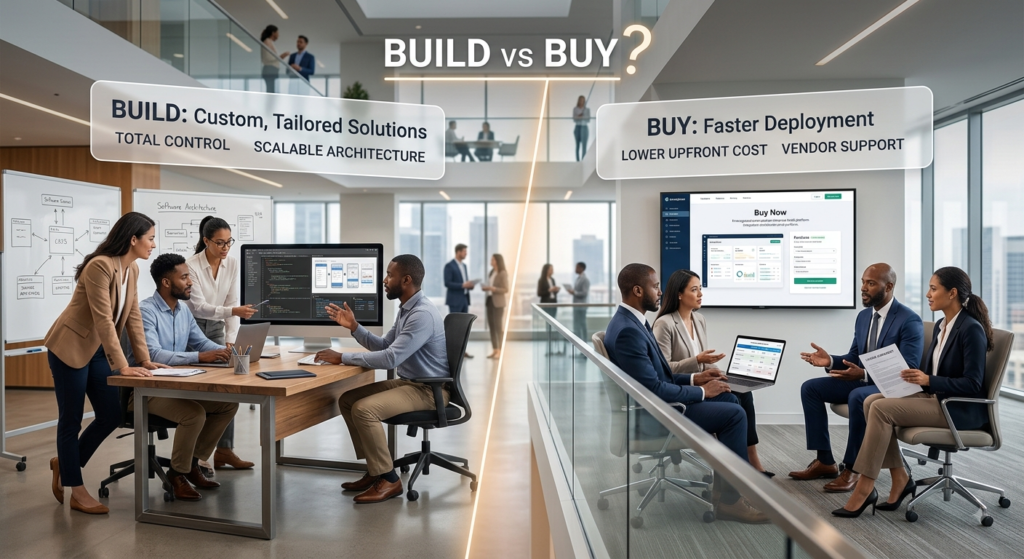
The build vs buy AI decision does not have a universal answer. It depends on your budget, talent, timeline, and strategic goals. Mid-sized companies should resist the pressure to choose one extreme. Instead, focus on matching each AI need with the right approach.
Start small. Test what works. Then scale thoughtfully from there. With the right framework, you can make confident decisions that support long-term growth. Build your authority with Ruben Ghosh, and get expert guidance on navigating your AI strategy with clarity and confidence.
1. What does build vs buy AI actually mean?
It refers to choosing between developing custom AI systems in-house or purchasing existing AI software from a vendor. Each approach has different costs, timelines, and levels of control.
2. Is buying AI cheaper than building it?
Often yes, at least initially. Buying AI usually has lower upfront costs. However, subscription fees can add up over time, so long-term costs deserve careful review.
3. How long does it take to build AI in-house?
Timelines vary widely based on complexity. Simple projects may take a few months. Complex custom systems can take a year or longer to fully develop and refine.
4. Can mid-sized companies do both build and buy AI?
Yes, many companies use a hybrid approach. They buy tools for standard needs and build custom AI for unique, high-value use cases.
5. What is the biggest risk of building AI in-house?
The biggest risk is underestimating the time, talent, and ongoing maintenance required. Without strong technical resources, custom AI projects can stall or exceed budget.
