
The world has changed. And so has the corner office. Not too long ago, a CEO’s job was fairly straightforward. Set strategy. Manage people. Drive profits. But today? The modern CEO is expected to do something far more complex. They must lead organizations through constant digital disruption — while staying human, empathetic, and visionary at the same time. This is the era of the digital CEO. And it’s rewriting everything we thought we knew about business leadership.
First, let’s clear something up. A digital CEO is not just a CEO who uses a smartphone or approves an IT budget. That definition is far too narrow.
A digital CEO is a leader who places technology, data, and innovation at the core of their business strategy. They don’t just understand digital tools — they use them to drive decision-making, reshape customer experience, and build competitive advantage.
In short, they lead with technology, not just alongside it.
The shift is significant. According to McKinsey, companies led by digitally fluent executives are far more likely to outperform competitors. They move faster. They adapt better. And they grow more sustainably.
Think about what’s happened in the last decade alone. Cloud computing transformed infrastructure. AI disrupted entire industries. Remote work redefined company culture. And customer expectations evolved at lightning speed.
As a result, traditional leadership models simply can’t keep up. The old playbook focused on stability, hierarchy, and slow deliberate change. But today’s business environment rewards agility, experimentation, and digital-first thinking.
Moreover, companies that ignore digital transformation aren’t just falling behind. They’re becoming irrelevant.
Blockbuster ignored streaming. Kodak dismissed digital photography. Borders underestimated e-commerce. Each of these companies had skilled, experienced CEOs. But none of them had a digital CEO mindset.
The lesson is clear. Leadership evolution isn’t optional anymore. It’s a survival strategy.
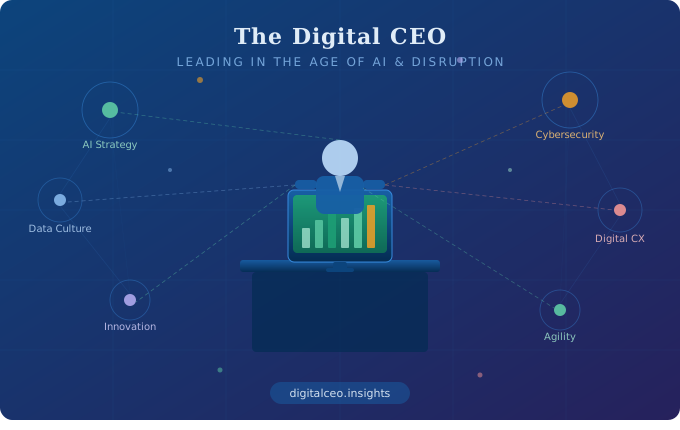
So, what does a digital CEO actually do? Let’s break it down.
Data is the new oil. But unlike oil, it only has value when it’s refined and acted upon. A digital CEO builds a culture where data isn’t locked in IT departments. Instead, it flows across every function — from marketing to HR to operations.
They ask the right questions. What does the data tell us? Where are the patterns? What decisions should we change based on evidence?
Furthermore, they invest in analytics tools, hire data-literate leaders, and ensure that gut instinct is always backed by insight.
Artificial intelligence is no longer a future concept. It’s happening now, across every sector. And yet, many organizations are still treating AI like a buzzword rather than a business tool.
Digital CEOs are different. They understand AI’s real potential — and its real limitations. They champion responsible AI adoption, ensuring that automation enhances human work rather than simply replacing it.
More importantly, they ensure AI is used ethically, transparently, and in line with company values.
Here’s a hard truth. Digital transformation fails when it starts in the middle. It succeeds when it starts at the top.
A digital CEO doesn’t delegate transformation to a Chief Digital Officer and walk away. Instead, they are deeply involved. They set the vision and remove roadblocks. They celebrate digital wins publicly and take accountability for setbacks.
Because ultimately, culture follows leadership. When employees see their CEO genuinely committed to change, they follow.
Cybersecurity used to be an IT problem. Not anymore. A single breach can cost millions in fines, destroy customer trust, and wipe out years of brand equity.
Digital CEOs treat cybersecurity as a board-level issue. They demand regular risk assessments. They ensure data privacy compliance. And they make sure that security is built into every product, process, and partnership — not bolted on as an afterthought.
Today’s customers are digital-first. They expect seamless, personalized, fast experiences — whether they’re shopping online, contacting support, or using a mobile app.
A digital CEO constantly asks: Is our digital customer experience better than our competitors’? If the answer is “no” or “I don’t know,” that’s a problem.
They invest in UX, personalization technology, and omnichannel strategies. Because customer loyalty in the digital age is earned one interaction at a time.
Beyond skills and responsibilities, being a digital CEO requires a fundamental mindset shift. Let’s look at what that means in practice.
Embrace Continuous Learning
Technology evolves constantly. Therefore, the digital CEO can never stop learning. They read widely and attend industry events. They experiment with emerging technologies firsthand and surround themselves with people who challenge their assumptions.
This isn’t weakness — it’s wisdom.
Tolerate Intelligent Failure
Innovation requires experimentation. And experimentation means some things won’t work. A digital CEO builds a culture where smart risks are encouraged, failure is analyzed (not punished), and lessons are applied quickly.
This mindset shift is especially hard for traditional leaders. But it’s absolutely essential in a fast-moving digital landscape.
Think Platform, Not Product
The most successful digital businesses aren’t just selling products. They’re building ecosystems. Think Amazon, Apple, or Salesforce. Each of these companies created platforms that others build on — multiplying value exponentially.
A digital CEO thinks in platforms. They ask: How do we create a business model where value grows with every participant?
Here’s something that often gets lost in the conversation about digital leadership. Technology is only part of the story.
At its heart, the digital CEO is still a human leader. They must inspire trust. Build inclusive teams. Communicate clearly. And make decisions that reflect both business goals and human values.
In fact, as automation takes over more routine tasks, soft skills become more valuable — not less. Empathy, storytelling, ethical judgment, and the ability to build culture across hybrid or remote teams are all critical CEO competencies right now.
The best digital CEOs combine technical fluency with emotional intelligence. That combination is rare. And it’s exactly why it’s so powerful.
This isn’t just about individual leaders. Organizations also have a role to play.
Boards must prioritize digital literacy when selecting and evaluating CEOs. Shareholders should demand clear digital strategies — not vague commitments to “embrace innovation.”
Additionally, executive development programs must evolve. Leadership coaching, digital upskilling, and exposure to emerging technologies should be standard for any C-suite leader.
Because the digital CEO doesn’t exist in isolation. They need a board, a team, and an organization that’s ready to move with them.
Looking ahead, the role of the digital CEO will only become more complex — and more critical.
Generative AI, quantum computing, and Web3 technologies are already on the horizon. The metaverse is reshaping commerce and collaboration. Geopolitical risks are affecting digital supply chains.
Consequently, tomorrow’s digital CEO must be part strategist, part technologist, part ethicist, and part futurist. They must balance short-term performance with long-term digital transformation. They must protect their organization while simultaneously disrupting it.
It’s a demanding role. But it’s also one of the most exciting leadership opportunities in business history.
The digital CEO isn’t a mythical figure from Silicon Valley. They’re emerging in every industry — from finance and healthcare to retail and manufacturing.
And the question for every leader today is simple. Are you evolving fast enough?
Because the companies that will win in the next decade won’t just have the best products. They’ll have the best digital leadership. The most adaptable cultures. And CEOs who genuinely understand that the future belongs to those who build it — one data point, one innovation, one bold decision at a time.
The new era of leadership has already begun. The only question is: are you leading it?
Ready to lead the digital revolution? Share this post with a CEO who needs to read it.
Read More:
