
Artificial Intelligence (AI) is changing business fast. Therefore, every company wants to use it. But, a big question always comes up. Should you build AI solutions with your own team? Or, should you work with an outside AI partner? Truly, this choice impacts how fast you grow. It also affects your costs.
Some leaders think only an in-house team gives full control. But, this can be slow. It can also be very expensive. Building an AI team needs special skills. Furthermore, these skills are hard to find. Always remember, the best choice depends on your specific goals. By understanding the pros and cons of each approach, you can decide what scales better for your business. This decision can save you much time and money. It also helps you stay ahead of the competition.
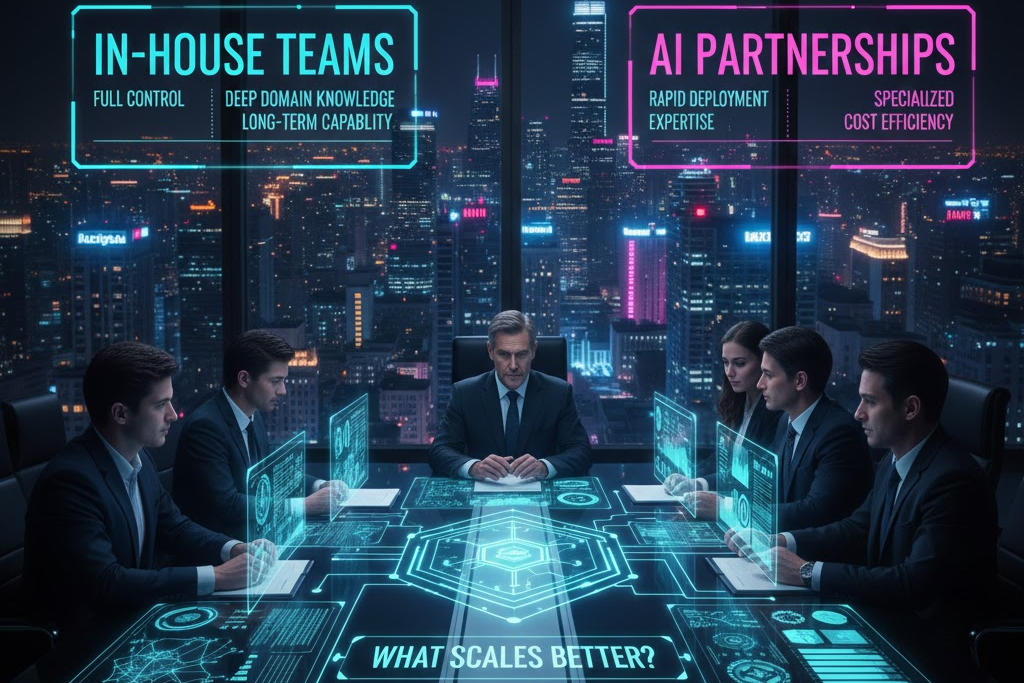
First, let’s look at the central dilemma. Companies want to use AI. However, they must choose how to get it. This is a big decision for rapid growth. Clearly, each path has its own set of challenges. Therefore, understanding these paths helps you choose wisely.
Many companies struggle with AI adoption, regardless of the path:
The “in-house vs. partnership” decision directly addresses these challenges. It helps companies decide how to best overcome them.
So, what exactly does “scales better” mean in the context of AI? It means finding the most efficient way to grow your AI capabilities. It also means doing this without hitting major roadblocks. Truly, it refers to your ability to expand quickly. You must do this while managing costs, talent, and speed.
Here are the key aspects of scaling AI capabilities:
Truly, an approach that “scales better” performs well across most of these points. It allows a business to grow its AI use without breaking the bank or slowing down.
The first option is building an in-house AI team. This means hiring your own experts. They work only for your company. Clearly, this path offers maximum control over your AI strategy. Therefore, it is often seen as the most secure way to build core AI capabilities.
Firstly, an in-house team offers full control. You own all the intellectual property. You also decide every detail of the development. Secondly, you get deep domain knowledge. Your team learns your business inside out. They tailor AI solutions very precisely to your specific needs.
Furthermore, you have direct communication. Your AI experts are always nearby. They can work closely with other departments. Also, you build long-term capability. Over time, your company develops strong AI skills. This can be a major strategic advantage. Lastly, you achieve brand integration. Your AI solutions become a unique part of your company’s brand and offerings. Truly, building an in-house AI team is a powerful choice for companies. This choice allows them to make AI a core, unique part of their business strategy.
Despite the benefits, building an in-house AI team also comes with significant challenges. These can often hinder scalability. Clearly, the difficulties often revolve around resources. Therefore, companies must carefully weigh these potential roadblocks.
Firstly, cost is a major factor. Hiring top AI talent is very expensive. You also need to pay for tools, infrastructure, and training. Secondly, talent acquisition is hard. There is a global shortage of AI experts. Finding and keeping them is a constant battle.
Furthermore, development is slow. Building complex AI models from scratch takes much time. This can delay your time to market. Also, maintenance is ongoing. AI models need constant updates and monitoring. This requires dedicated resources forever. Lastly, there is risk of stagnation. Your team might fall behind on new AI trends. They might not have access to the latest research. Truly, for many businesses, these challenges can make the in-house path difficult to scale quickly.
The second option is forming AI partnerships. This means working with outside companies. These companies specialize in AI development. Clearly, this path offers speed and access to specialized expertise. Therefore, it is often a faster way to integrate AI solutions.
Firstly, partnerships offer rapid deployment. External teams often have pre-built models or platforms. They can get solutions up and running much faster. Secondly, you gain specialized expertise. Partners often have deep knowledge in specific AI areas. They also have experience with many industries.
Furthermore, partnerships bring cost efficiency. You pay for specific projects or services. You avoid the high overhead of full-time salaries. Also, you get access to top talent. You can tap into a global pool of AI experts without hiring them. Lastly, partnerships offer flexibility. You can work with different partners for different needs. You can scale services up or down as needed. Truly, partnering for AI allows businesses to quickly leverage advanced technology. This happens without the heavy investment and long hiring process of an in-house team.
While partnerships offer many benefits, they also come with their own set of challenges. These can impact control and long-term strategy. Clearly, understanding these potential pitfalls is important. Therefore, companies must choose partners carefully.
Firstly, there is less control. You might have less say in the day-to-day development process. Secondly, intellectual property (IP) can be an issue. You must have clear agreements on who owns the AI models or data developed.
Furthermore, communication can be a challenge. Misunderstandings can happen with external teams. Also, there is a dependency risk. You rely on the partner for support and updates. If they stop supporting a product, you might face issues. Lastly, integrating solutions can still be complex. The partner’s solution needs to fit well with your existing systems. Truly, carefully chosen partners are essential. You must have clear contracts and good communication to avoid these potential issues.
Choosing between in-house AI and partnerships is not a one-size-fits-all decision. The best path depends on your company’s unique situation. Clearly, a clear understanding of your needs is vital. Therefore, consider your specific goals and resources carefully.
Firstly, assess your core business needs. Is AI central to your main product? If so, consider building some expertise in-house. If AI is for supporting tasks, a partnership might be better. Secondly, evaluate your budget and timeline. Do you need a solution quickly? Are you on a tight budget? Partnerships often offer faster, more predictable costs.
Furthermore, consider your existing talent. Do you have any internal data scientists? Can you train them? Also, think about data sensitivity. If you handle highly sensitive data, an in-house team might offer more peace of mind. Lastly, look for a hybrid approach. Many companies use a mix. They build core, critical AI in-house. They partner for specialized or non-core AI tasks. Truly, by carefully answering these questions, you can make an informed decision. This decision will help your business scale its AI capabilities effectively and sustainably.
Yes, this is a common strategy. Many companies start with a partner to quickly test AI ideas. Then, they build an in-house team to take over and deepen the expertise once the AI proves its value.
You protect your data with strong legal agreements. These include Non-Disclosure Agreements (NDAs) and clear data privacy clauses. Always ensure the partner follows strict security protocols.
A hybrid approach means using both. You might have a small in-house team for strategic oversight and core AI. At the same time, you partner with external vendors for specific projects, specialized tasks, or advanced research.
Not necessarily. Your contract with the partner should clearly state who owns the intellectual property (IP) developed. You can negotiate for full ownership of custom solutions or licensing agreements.
Your company is ready if you have a significant budget. You also need a long-term vision for AI. Furthermore, you must have the ability to attract and retain specialized talent. Finally, you need a strong culture of innovation and data use.
Also Read: Why Speed of Execution (SoE) is the Most Important AI Metric
