
The business world changes very fast. Therefore, companies cannot just react. They must look ahead. They must try to see what is coming. This is called strategic foresight. It means trying to predict future market shifts. Truly, in today’s world, doing this without Artificial Intelligence (AI) is almost impossible. AI helps businesses see patterns. It helps them understand trends long before others do.
Many companies still rely on old ways to plan. They use past data. They also listen to experts. However, these methods often miss big changes. They are too slow. Consequently, businesses fall behind. Always remember, AI is a powerful tool for strategic foresight. It can process huge amounts of information. It can find weak signals of change. By using AI wisely, businesses can prepare for the future. They can also make better decisions. This leads to lasting success and growth.
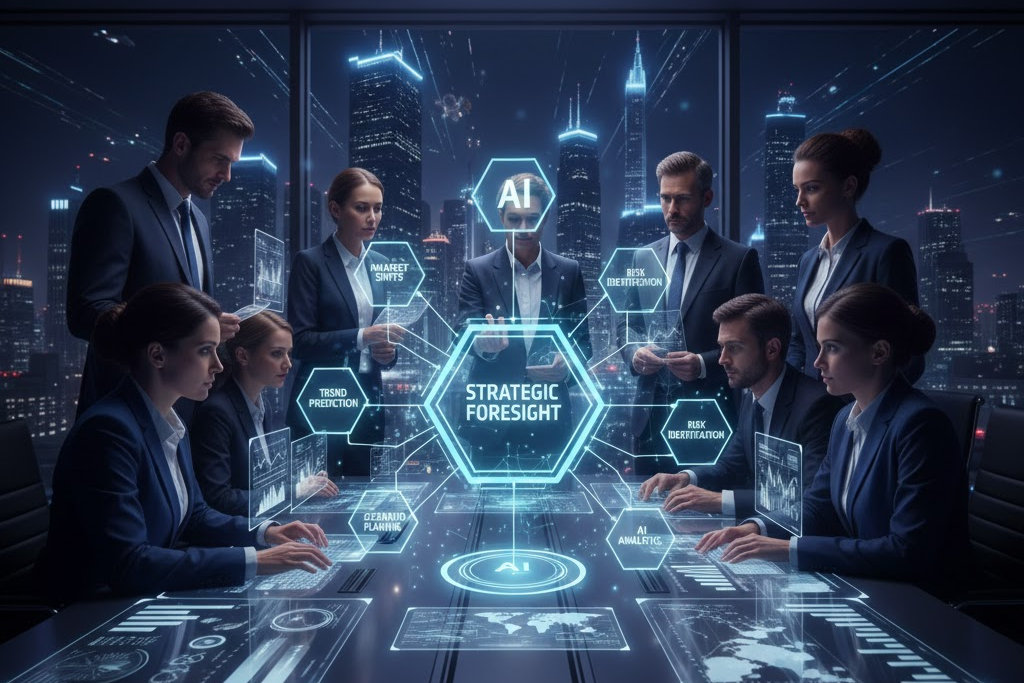
First, let’s understand why foresight is so vital now. Markets are not stable. They are full of surprises. New technologies, global events, and changing customer tastes can flip an industry overnight. Clearly, just reacting to these changes is too late. Therefore, businesses must become proactive. They must try to anticipate.
Old ways of predicting the future have limits. They often cannot keep up with today’s speed and complexity.
Here are some key limits of traditional foresight:
Strategic foresight with AI changes this. It helps businesses see what is coming and helps them prepare. It moves them from guessing to informed prediction.
So, what exactly is strategic foresight when we use AI? It is a method that combines human intuition with the vast power of AI which scans the horizon for early signs of change. It looks at many different types of data. Truly, AI helps identify emerging trends. It also helps predict their impact. This gives businesses a powerful “future compass.”
Here is how AI supercharges strategic foresight:
Truly, strategic foresight with AI moves businesses from being reactive to being truly proactive. It helps them build strategies for many possible futures, not just one.
The first major way AI helps with strategic foresight is its unmatched ability to scan the horizon. It goes far beyond what any human team can do. It looks for “weak signals” of change across vast and diverse datasets. Clearly, this broad view is vital for spotting disruptive trends early. Therefore, AI acts as an early warning system for the future.
Firstly, AI can process unstructured data. This includes the text from millions of news articles, research papers, forums, and social media posts. It understands the context and sentiment. It finds mentions of new technologies, changing consumer attitudes, or geopolitical shifts. Humans would take years to read all this.
Secondly, AI performs sentiment analysis. It can tell if public opinion about a product, technology, or social issue is changing. A slight negative shift in online conversations might signal a future market rejection. This helps predict consumer behavior. Furthermore, AI connects seemingly unrelated data points. It might see a new material science breakthrough and might also see rising interest in sustainability. It could then predict a shift in packaging design. These connections are hard for humans to make.
Additionally, AI can monitor patent filings and scientific publications. These are often early indicators of future technology and industry shifts. By tracking these, AI can predict which innovations will become important. Truly, by scanning the horizon with such depth and speed, AI gives businesses a powerful head start. It allows them to detect even the faintest whispers of future change.
Once AI spots the signals, the second pillar is its power in predictive modeling. This means AI does not just show you data. Instead, it uses that data to forecast what will likely happen next. Clearly, this move from observation to prediction is where AI offers immense value. Therefore, businesses can use these predictions to guide their plans.
Firstly, AI can build complex statistical models. It looks at historical data, current trends, and many different variables. Then, it predicts future market growth. It can also predict changes in customer demand. It can even predict the adoption rates of new technologies. These models are much more accurate than simpler human-made forecasts.
Secondly, AI excels at scenario forecasting. It can run thousands of simulations. Each simulation explores a different “what if” scenario. For example, “What if interest rates rise by 2%?” or “What if a major competitor fails?” The AI shows the likely outcomes for each scenario. This helps businesses prepare for various futures. Furthermore, AI can identify causal relationships. It can show why certain events lead to others. For instance, it might show that a certain social media trend causes a surge in demand for a specific product type. This deeper understanding helps in strategic planning.
Additionally, AI supports early trend identification and trajectory mapping. It can not only spot a new trend but also predict how quickly it will grow. AI predicts when it will peak and when it might decline. This helps businesses time their market entries and exits perfectly. Truly, by offering such powerful predictive capabilities, AI moves strategic foresight from guesswork to a science. It empowers companies to act with informed confidence about what lies ahead.
Identifying future trends is one thing. Understanding their impact and preparing for them is another. Therefore, the third pillar is AI’s ability to simulate impact and stress-test strategies. This allows businesses to see how future shifts will affect them. It also lets them test their plans against different futures. Clearly, this helps make strategies more robust and resilient.
Firstly, AI can create digital twins of your business or market. This is a virtual copy. You can then run simulations on this digital twin. You can see how a predicted market shift (e.g., a new competitor, a raw material price jump) would impact your sales, profits, and operations. This is like a safe sandbox for testing.
Secondly, AI can stress-test existing strategies. You have a five-year plan. The AI can run that plan against various challenging future scenarios. It might show that your plan works well in a stable market. However, it might fail if a specific disruption happens. This helps identify weak points in your strategy. Furthermore, AI can evaluate new strategic options. When a new opportunity arises, the AI can model its potential returns and risks. This helps businesses choose the best path forward. For example, it can predict the market share gained from a new product launch under different conditions.
Additionally, AI can help with resource allocation. If AI predicts a surge in demand for a certain product line, it can also suggest how many resources (staff, materials, budget) would be needed to meet that demand. This helps optimize investment. Truly, by simulating future impacts and stress-testing strategies, AI enables businesses to build flexible plans. They can adapt to whatever the future holds. They can move with confidence.
Implementing AI for strategic foresight is a journey. It requires more than just buying software. It needs careful planning, the right people, and a smart approach. Clearly, success comes from integrating AI into your existing strategic processes. Therefore, following these best practices will help you get the most from this powerful tool.
Firstly, start small with clear goals. Do not try to predict everything at once. Pick one specific area to focus on. For example, “What will be the next big trend in consumer tech?” or “What are the biggest risks to our supply chain in 3 years?” This makes the project manageable. Secondly, ensure high-quality data. AI is only as good as the data it gets. You need clean, relevant, and diverse data sources. This includes internal company data and external market information.
Furthermore, combine AI with human expertise. AI provides the insights. However, human strategists must interpret them. They must add context. They must also make the final decisions. It is a partnership. Also, build a cross-functional team. Bring together data scientists, strategists, market experts, and technology leaders. Each perspective is valuable. Lastly, invest in continuous learning. The AI models will need regular updates. Your team will need ongoing training. The future is always changing, so your foresight process must also adapt. Truly, by following these best practices, businesses can successfully embed AI into their strategic foresight process. This helps them navigate future uncertainties with greater clarity and confidence.
No, AI for strategic foresight is becoming accessible to all. While big companies have more resources, many AI tools are now available through cloud services. Even smaller businesses can start using AI to track specific market trends or analyze customer behavior.
Absolutely not. AI is a powerful tool to enhance human capability. It processes vast data and spots patterns that humans cannot. However, human strategists still provide critical intuition, ethical judgment, context, creativity, and decision-making that AI cannot replicate. It is a human-AI partnership.
AI uses a wide range of data. This includes structured data (sales figures, economic indicators) and unstructured data (news articles, social media posts, patent filings, scientific journals, customer reviews, forum discussions). It combines these to get a full picture.
AI predictions are generally more accurate than traditional methods because they process more data and find complex patterns. However, no prediction is 100% certain. AI provides probabilities and likely scenarios. It helps reduce uncertainty, but it does not remove it entirely. Human judgment remains crucial.
The first step is to identify a specific, high-priority business question related to the future (e.g., “What’s the next big tech trend affecting our industry?”). Then, start a small pilot project. Use readily available AI tools to collect and analyze relevant data for that specific question. This helps build experience and show value.
Also Read: Can Generative AI Analytics Give Your Board an Edge?
