
In today’s rapidly evolving business landscape, artificial intelligence (AI) is no longer a distant technology; instead, it is an immediate imperative. For C-suite leaders, the challenge extends beyond merely adopting AI tools; truly, it involves fundamentally transforming the organization’s culture to embrace intelligent execution. This means embedding AI into every layer of decision-making, operational processes, and strategic planning, fostering an environment where data-driven insights and automation are the norm. Therefore, developing a comprehensive AI playbook at the executive level is not just advantageous; it is absolutely essential for sustained innovation and competitive advantage.
Many executives view AI as a departmental project or a technical endeavor. However, this narrow perspective often leads to fragmented efforts, limited impact, and a failure to scale AI across the enterprise. A true culture of intelligent execution, on the other hand, recognizes AI as a strategic lever that touches every aspect of the business. It requires active leadership, a clear vision, and a commitment to continuous learning and adaptation.
Always remember, AI is a team sport, and its success hinges on how well the entire organization, from top to bottom, is aligned and empowered to leverage its capabilities. By building such a culture, C-suite leaders can unlock unprecedented levels of efficiency, insight, and agility, redefining what’s possible for their organizations.
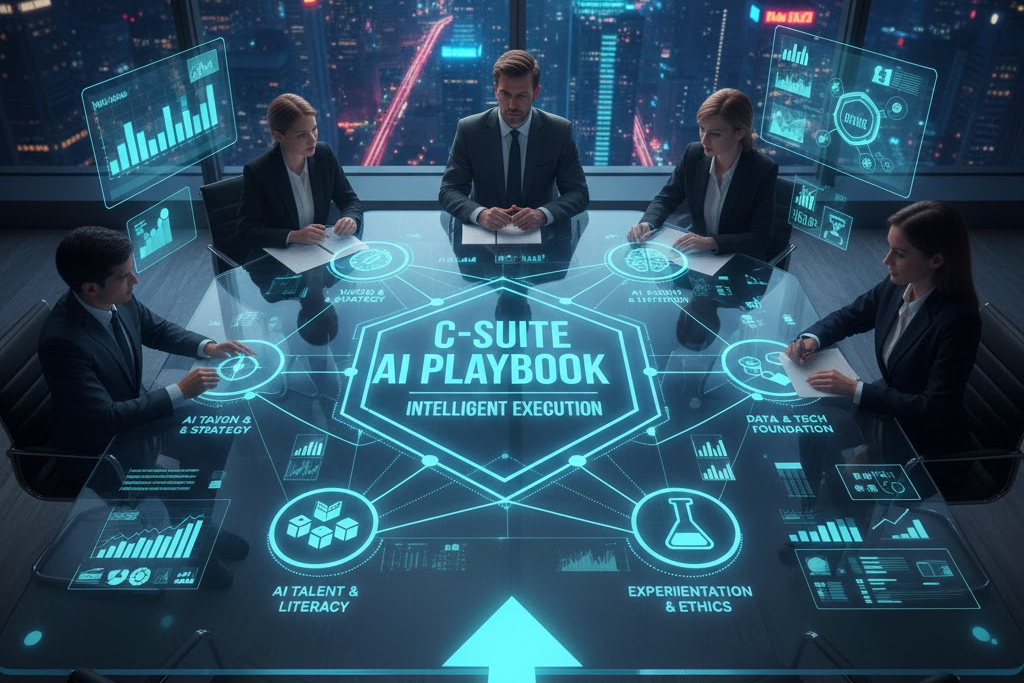
To begin with, let’s firmly establish why building an AI-driven culture of intelligent execution is an immediate imperative for the C-suite. The stakes are incredibly high. Organizations that successfully integrate AI are gaining significant competitive advantages, outperforming rivals in efficiency, customer experience, and innovation. Conversely, those that lag risk obsolescence. Clearly, AI is not just a technological trend; instead, it is a fundamental shift in how businesses operate and create value.
Many companies approach AI with a project-centric mindset, launching isolated initiatives without a cohesive, overarching strategy. This often leads to “AI pilots” that fail to scale or deliver lasting impact. A culture of intelligent execution, however, transforms this fragmented approach into an AI-first mindset. This means:
Furthermore, an AI-driven culture proactively addresses challenges like data governance, ethical AI, and change management. It recognizes that successful AI adoption requires not just technology, but a fundamental shift in organizational behavior and values. Truly, the C-suite’s role is to champion this transformation, moving the organization from merely doing AI to being an AI-powered enterprise. This strategic leadership is paramount for navigating the complexities and fully realizing AI’s immense potential.
The cornerstone of any successful AI transformation, and thus the first pillar of the C-Suite AI Playbook, is establishing a crystal-clear AI vision and strategy. Truly, without a guiding purpose, AI initiatives risk becoming disparate experiments lacking coherence and direction. Instead, C-suite leaders must articulate why AI matters to their organization, what specific problems it will solve, and how it aligns with broader business goals. Therefore, this strategic clarity is essential for unifying efforts and inspiring organizational buy-in.
Firstly, your AI vision must directly link to your organization’s overarching mission and strategic objectives. Ask: How will AI help us achieve our primary goals, whether that’s enhancing customer experience, reducing operational costs, accelerating innovation, or entering new markets? Clearly, the vision should be inspiring yet pragmatic, setting realistic expectations while outlining transformative potential. For example, a retail company’s AI vision might be: “To use AI to personalize every customer interaction, from discovery to post-purchase support, driving loyalty and revenue.”
Secondly, translate this vision into a concrete AI strategy with defined pillars and initial use cases. This involves identifying high-impact areas where AI can deliver immediate value, building momentum and proving ROI early on. Consider areas like:
Even the most brilliant AI strategy will falter without the right people to execute it. Therefore, the second critical pillar of the C-Suite AI Playbook focuses on cultivating AI literacy across the organization and developing specialized talent. Truly, AI is not just for data scientists; instead, every employee, from front-line staff to senior managers, needs a foundational understanding of AI’s capabilities and implications. Clearly, a failure to invest in human capital will severely limit the reach and effectiveness of any AI initiative.
Firstly, the C-suite must commit to widespread AI literacy programs. These initiatives should demystify AI, explain its business relevance, and educate employees on how AI will augment their roles, rather than replace them. This includes:
Secondly, a strategic approach to talent development is paramount. This involves a dual strategy of upskilling/reskilling existing employees and making strategic new hires. Identify critical skill gaps in areas like data science, machine learning engineering, MLOps, and AI ethics. Invest in certifications, mentorship programs, and internal academies to build these competencies. Furthermore, empower non-technical roles to become “AI translators”—individuals who can bridge the gap between technical AI teams and business users. Truly, by nurturing a knowledgeable and adaptable workforce, the C-suite ensures the organization has the human capital required to not just deploy AI, but to truly execute intelligently and continuously innovate with it.
AI models are only as good as the data they consume and the infrastructure they run on. Therefore, the third crucial pillar of the C-Suite AI Playbook involves building a robust data and technology foundation. Clearly, without high-quality, accessible data and scalable infrastructure, AI initiatives will struggle to move beyond pilot projects into production-ready solutions. Truly, this foundational work is often underestimated but is absolutely critical for sustainable AI success.
Firstly, establish comprehensive data governance frameworks. This means defining clear policies for data collection, storage, quality, privacy, security, and ethical use. Invest in tools and processes for data cleaning, integration, and lineage tracking. Without clean, reliable data, AI models will produce biased or inaccurate results, eroding trust and undermining value. Furthermore, ensure data is easily accessible to authorized AI teams, breaking down traditional data silos.
Secondly, invest in scalable technology infrastructure. This often involves leveraging cloud-based AI platforms (e.g., AWS, Azure, Google Cloud) that offer elastic compute resources (GPUs, TPUs), specialized AI/ML services, and robust data storage. This provides the agility and power needed for both AI model training and deployment at scale.
Additionally, implement MLOps (Machine Learning Operations) practices from the outset. MLOps streamlines the entire lifecycle of AI models, from development and testing to continuous integration, deployment, monitoring, and retraining. This ensures that AI solutions are not just built, but also reliably operated and maintained in production. Truly, by prioritizing a strong data and technology foundation, the C-suite enables the organization to confidently build, deploy, and scale AI solutions, fueling a culture of intelligent execution with reliable insights.
Beyond technology and talent, the C-suite must actively foster a culture that embraces both experimentation and responsible AI. Truly, AI development is inherently iterative, requiring a willingness to test, learn, and adapt. Simultaneously, the ethical implications of AI are profound, demanding a proactive commitment to fairness, transparency, and accountability. Clearly, balancing these two aspects is critical for long-term trust and societal impact.
Firstly, champion a culture of experimentation and psychological safety. Encourage teams to explore new AI use cases, run proofs of concept, and learn from both successes and failures. Provide safe environments for experimentation (e.g., sandboxes) and celebrate learning outcomes, not just immediate wins. This agile approach allows the organization to discover new applications of AI quickly and adapt to emerging technologies. Remove the fear of failure, transforming it into a valuable learning opportunity.
Secondly, embed Responsible AI principles into every stage of your AI playbook. This includes:
The final and perhaps most crucial pillar of the C-Suite AI Playbook is leading with vision and actively managing organizational change. Truly, AI transformation is not merely a technical upgrade; instead, it is a profound shift in how an organization functions, impacting roles, processes, and decision-making. Therefore, the C-suite must act as the primary evangelists, guiding the organization through this change with clear communication, empathy, and consistent commitment.
Firstly, the C-suite must serve as the chief AI evangelists. Regularly communicate the AI vision, its strategic importance, and the benefits it will bring to employees, customers, and stakeholders. Use success stories from early AI pilots to build momentum and demonstrate tangible value. This consistent messaging helps to overcome skepticism and build excitement. Furthermore, establish a cross-functional AI steering committee led by senior executives to oversee the entire AI journey, ensuring alignment and resource allocation.
Secondly, implement a robust change management strategy. AI will inevitably alter job roles and workflows, which can cause anxiety among employees. Address these concerns directly by:
The most common mistake is treating AI as a purely technical project rather than a strategic, enterprise-wide cultural transformation. This often leads to isolated pilots, lack of cross-functional buy-in, and failure to integrate AI into core business processes and decision-making.
The C-suite ensures alignment by clearly defining an AI vision that directly supports overarching business objectives. This involves identifying specific, high-impact business problems that AI can solve, establishing measurable KPIs, and securing executive sponsorship for all major AI initiatives.
For non-technical employees, AI literacy means a foundational understanding of what AI is, how it works, its capabilities and limitations, and how it will impact their roles and workflows. It’s about empowering them to effectively interact with AI tools, interpret AI-generated insights, and trust AI systems.
AI development is often iterative and exploratory. A culture of experimentation encourages teams to test new AI use cases, learn from both successes and failures, and adapt quickly. This agile approach helps discover novel applications of AI and accelerates the organization’s ability to innovate without fear of immediate failure.
An AI ethics committee plays a crucial role in overseeing the responsible development and deployment of AI. It establishes guidelines for bias detection, transparency, human oversight, data privacy, and security, ensuring that AI initiatives align with the organization’s values and ethical principles, thereby building trust and mitigating risks.
