
Investing in artificial intelligence (AI) represents a massive undertaking for any business. Therefore, rushing into an AI project without preparation is simply a recipe for wasted time and money. Consequently, a comprehensive AI readiness assessment becomes the most critical first step. This essential evaluation helps you determine if your organisation possesses the right foundational elements—strategy, data, technology, and talent—to successfully deploy, manage, and scale AI solutions. Clearly, conducting this assessment beforehand ensures your expensive AI investment delivers a meaningful return on investment (ROI). Furthermore, this process helps you identify and address critical weaknesses, making your journey into AI adoption much smoother.
The entire process helps you align your AI ambitions with your true organisational capacity. In fact, many companies treat AI readiness as a one-time technical check, which is a significant mistake. Instead, you should view it as a continuous strategic review involving every core business function. Truly understanding your current state prevents blind spending on disconnected experiments. Always begin by answering one key question: is your business ready to support the full lifecycle of an AI solution? This detailed analysis will show you exactly where to focus your preparatory efforts.
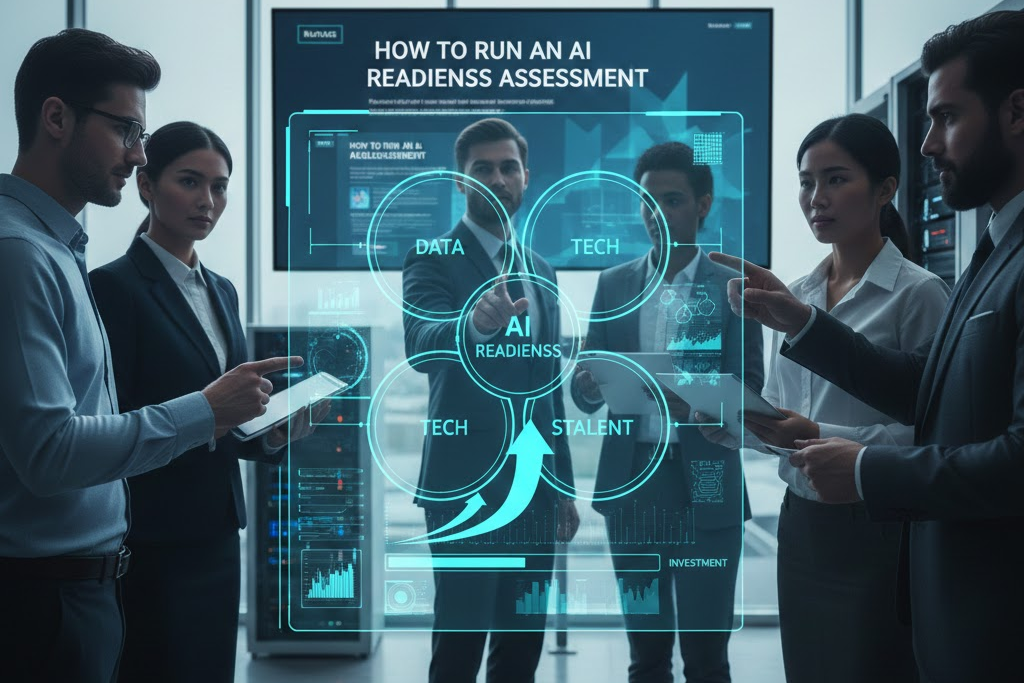
To begin with, every successful AI initiative must start with a clear connection to your core business strategy. Therefore, the first step in your AI readiness assessment involves defining specific, measurable, achievable, relevant, and time-bound (SMART) objectives for your AI investment. Furthermore, you must identify your core business challenges or user needs that AI is uniquely suited to solve. For example, do you aim to reduce customer service costs, improve demand forecasting accuracy, or accelerate product development?
Naturally, not all AI opportunities are created equal. Consequently, you must brainstorm potential AI use cases across different departments. Then, it is important to prioritise these ideas based on two main factors: potential business value and feasibility. Often, starting with high-impact, low-effort projects, often called “quick wins,” generates early momentum and proves the value of AI to stakeholders. This initial success builds internal confidence, which is quite helpful for tackling larger, more complex transformations later on.
First, you need to determine the potential ROI for each use case. Furthermore, you must assess the effort required in terms of data preparation, technology integration, and skill acquisition. By plotting these opportunities on a value-effort matrix, you can easily identify the best starting points. For instance, automating a repetitive back-office process might offer high value and low effort, making it an ideal pilot project. Always remember, the objective is to leverage AI to solve a specific, verified business problem, not merely to adopt new technology for its own sake.
Since data is the fuel for every AI engine, evaluating your organisation’s data maturity is arguably the most critical part of the assessment. Clearly, AI models require large quantities of high-quality, relevant data to train and function accurately. Therefore, a thorough data readiness audit must cover four key areas: quality, quantity, accessibility, and governance. You simply cannot ignore this step, as investing in AI tools before fixing data quality issues leads to costly failures.
First and foremost, you must audit the quality of your existing data assets. Data quality encompasses several dimensions, including accuracy, completeness, consistency, and timeliness. For example, an assessment should check for missing values, inconsistent formats, and outdated information across your databases. Furthermore, you must evaluate the quantity of your data. While some modern AI models can learn from less data, complex machine learning tasks still require substantial, well-labeled datasets for effective training. Consequently, insufficient or poor-quality data is the most common reason AI projects fail.
Next, you should evaluate data accessibility and integration. Data should not be siloed across different departments or legacy systems. Instead, AI initiatives thrive on unified, integrated data pipelines. Therefore, assess how easily your data can be cleaned, integrated, and moved to your chosen AI platform. Lastly, data governance and privacy are essential. This includes having clear policies for data ownership, security, role-based access controls, and compliance with regulations like GDPR or HIPAA. Truly robust governance ensures data integrity and mitigates ethical and legal risks.
A strong technical foundation is essential for supporting the unique computational demands of AI workloads. Therefore, the next step in the readiness assessment involves a detailed audit of your existing technology stack and infrastructure. This review determines if your current systems can handle the sheer processing power, storage volume, and network demands of AI models, both during training and when deployed for live inference.
Firstly, you need to examine your compute power and storage solutions. AI model training is computationally intensive, frequently requiring specialized hardware like Graphics Processing Units (GPUs) or dedicated cloud resources. Therefore, you must assess whether your current on-premise infrastructure or cloud setup can scale dynamically to meet these demands. Furthermore, legacy systems and fragmented architecture can easily bottleneck AI performance.
Secondly, you must evaluate the integration capabilities of your existing software. Will your new AI solutions integrate seamlessly with your core business systems, such as CRM, ERP, and supply chain tools? Also, you should consider the use of modern development and deployment practices like MLOps (Machine Learning Operations). Clearly, a robust MLOps pipeline streamlines the process of taking an AI model from development to production, which greatly enhances operational readiness. Conversely, without proper integration and scalable infrastructure, your AI investments will quickly become isolated, underperforming experiments.
Technology and data are only part of the equation; people and culture are equally, if not more, important for long-term AI success. Therefore, your assessment must include a thorough review of your workforce’s current skills and your organisation’s cultural readiness for change. An AI project will fail if the internal team lacks the necessary expertise to build, deploy, maintain, and—critically—interpret the results of AI models.
To start, conduct a detailed skills inventory to map your existing competencies in areas like data science, machine learning, AI ethics, and data engineering. Consequently, you will quickly identify where your team has gaps. You must plan a two-pronged strategy to fill these holes: upskilling your current employees through targeted training programs and considering new hires or external partnerships for highly specialised roles. Additionally, you should not overlook the need for AI literacy across the entire organisation. Even non-technical staff must understand how AI is changing their workflows and how to trust and interact with AI-driven tools.
Moreover, cultural readiness and change management are vital components. Is your leadership committed to a long-term AI vision? Is the organisation open to adopting new, sometimes disruptive, workflows? Successfully integrating AI often requires significant changes to processes and roles. Therefore, you need a proactive change management plan to address potential employee resistance and foster a culture of data-driven decision-making. Since executive sponsorship is crucial, securing top-level commitment ensures the AI initiative remains a strategic priority.
Finally, before making a major investment, you must establish robust governance frameworks and a clear financial plan. Certainly, responsible AI adoption requires proactive management of ethical, legal, and regulatory risks. Therefore, this final phase ensures your investment is not just technologically sound but also morally and financially sustainable.
Firstly, you must implement a framework for Responsible AI. This addresses critical issues such as algorithmic bias, transparency, and the need for human oversight. You must define clear policies for how AI models are developed, validated, and monitored to ensure they are fair, accurate, and compliant. Furthermore, compliance with data privacy laws is non-negotiable.
Secondly, you need a precise financial readiness plan that goes beyond the initial procurement cost. The calculation of ROI must factor in both tangible benefits (like cost reduction or revenue growth) and intangible benefits (like improved decision-making or enhanced customer experience). Importantly, your budget must account for ongoing operational expenses, including data maintenance, cloud compute costs, model monitoring, and continuous upskilling. Indeed, a thorough financial review proves that your AI investment will generate measurable, positive business outcomes. Furthermore, this comprehensive assessment creates a solid foundation, significantly reducing risk and maximizing the chances of a successful AI rollout.
The most common reason for AI project failure is poor data quality, or “garbage in, garbage out.” An AI readiness assessment directly addresses this by conducting a thorough data audit, which checks for completeness, accuracy, and consistency. This crucial step forces the organisation to clean, unify, and govern its data before any costly model development begins.
You should not treat AI readiness as a one-time project. Instead, perform a comprehensive assessment at least once every 12 to 18 months. Furthermore, a smaller, more focused check should happen before starting any new major AI initiative. Truly, the rapidly evolving nature of AI technology and changing business needs necessitates continuous re-evaluation.
For non-technical employees, the assessment focuses on “AI literacy” and change management readiness. Truly, it involves gauging their understanding of how AI will impact their jobs, their willingness to adopt new processes, and their ability to interpret AI-generated insights. This part ensures organisation-wide buy-in and reduces internal resistance.
You should prioritise use cases that offer the highest business value with the lowest implementation effort. These “quick wins” are typically repetitive, data-rich processes with clear, measurable outcomes. These early, successful projects build internal momentum and prove the ROI potential before you commit to larger, riskier transformations.
Skipping the governance and ethics review exposes your organisation to serious risks, including regulatory non-compliance, financial penalties, and significant reputational damage from biased or opaque algorithmic decisions. Clearly, establishing an ethical AI framework is essential for building trust with customers and maintaining legal standing.
Also Read: What is the AI Adoption Framework for SMEs: Full Guide
